 Daiwong's Website
Critical Evaluation of Simplified Chinese Characters
In this blog, I will be critically evaluating certain Simplified Characters and determining whether the simplification process is excellent to poor.
Although I am in favour Traditional Chinese Characters and both writing systems have their strong proponents whom enjoy criticising the other side mainly based on political grounds. The aim on this blog is purely constructive and judge characters on the basis of meaning, legibility and readability without bias or political factors.
My definition of a good simplification is one to these few factors:
- Reverting to archaic variants. i.e. 雲=云, 爲=为
- Removing unnecessary repetitions. i.e. 蟲=虫, 齒=齿
- Using a phonetic component. i.e. 態=态, 嚇=吓
- Systematic simplification. 門=门, 車=车
Good Simplifications
I believe it is acceptable for some characters to be simplified if the core meaning or core phonetic component is retained and remove archaic redundancy.
- 燈 = 灯
- The word for “light” has it’s original component 登 dang1 replaced with 丁ding1. Though this is slightly different, its little variation of sound makes it acceptable. (This also applies to: 膠 = 胶, 園,遠 = 园,远)
- 點 = 点
- The word for “dot/point” or “why” in Cantonese has a redundant radical 黑 “black”. Since the meaning of the word itself is already vague. This is an acceptable simplification. (This also applies to: 雙 = 双, 戔 = 戋, 𤔡/為 = 为)
- 淚 = 泪
- The word for “tear” was simplified to represent “氵” which is the radical for “water”and “目” for “eye”. Thus, the meaning and radical is retained; a great simplification. (This can also apply to: 從 = 从, 寶 = 宝, 氣 = 气)
Sloppy Simplifications
There are some simplifications that are understandable, however they lack consistency with other characters or radicals. This actually may create the learning process harder due to more rote memorisation of “new” characters. As opposed to repetition components of characters that allow you to remember easier with pre-existing Kangxi formats (which is formatting for all Chinese characters)
鷄=鸡, 難=难, 觀=观, 鄧=邓, 漢=汉 The overuse of “又” which means “and also” is just plain lazy in the simplification process. Any character that has a complex component would just be replaced with 又 for some reason. Zero consistency and removes meaning.
This also goes for 乂 seen in 風=风, 罔=冈, 趙=赵and 文 meaning “language” for 劉=刘, 這=这
貝=贝, 見=见 are simplified in a way that does not follow the Kangxi format. However, it is still understandable; necessary evil.
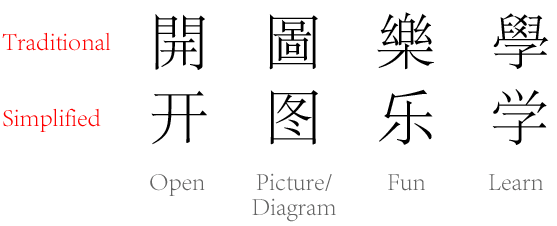
將 将 but 醬 酱 which shows the lack of consistency and makes it harder to remember components of characters. This could also be seen with the door radical where the 門 = 门 is fine, thus 問間閃閂=问间闪闩 which is totally okay. However why does 開關 get simplified into 开关?
Poor Simplifications
Merging Characters is a major contributor in poor simplification, this involves either taking similar meaning characters (which you can get away with) or characters with the same phonetics and replacing them with their simpler counterpart (which are distinct in traditional Chinese) that may not share the same meaning or sound. Thus, simplified users would have to identify the word based on context rather than the character itself for its meaning.
Notable characters that were simplified by merging include (Note - all English translations will be provided for traditional Chinese meanings, in simplified Chinese the meanings are combined I.e in simplified Chinese “里” can mean inside and kilometer):
- “裹” (inside) = “里” (kilometer)
- “糓” (grain) = “谷” (valley)
- “蔔” (carrot) = ”卜” (“bok” sound; something crispy)
- “齣” (a play) = ”出” (out)
- “發” (prosperity) ”髮” (hair) = “发”
- “亁” (dry) ”幹” (pole) = ”干”
- “鬱” (depression) = ”郁” (move)
- “臺” (platform) ”檯” (table) ”颱” (typhoon) = “台” (archaic form of platform)
- “隻” (a unit of) ”祇” (just) = “只” (only)
- “後” (back) = “后” (empress)
- “衝” (rush through) = “冲” (flush)
- “麵” (noodles) = “面” (face)
- “闆” (owner) = “板” (board)
Many simplified characters were simplified in the number of strokes while retaining the shape of the character, however their meanings have completely been removed.
- 進 = 进 (advance; get through)
- In traditional the 辶 (辵) walking radical is used, and 隹 small tailed bird component is used. As birds tend to fly through and advance. However, in simplified. 隹 was replaced with 井 which means well. Thus, in simplified the character can be interpreted as “walking into a well” to mean (advance). Since Chinese characters carry meaning and this character can be seen as auspicious. This is a horrible simplification. Similar simplifcations can include: 講 = 讲
- 聽 = 听 (listen)
- In traditional the ear radical is used and components include heart. As you need your heart to focus and listen with your ear. However in simplified, it has the mouth radical and “catty” component which is a form of measurement in Chinese.
- 聲 = 声 (hear)
- Again, the ear radical was removed in the simplified version.
- 產 = 产 (create)
- The simplified version removes the character for life or birth.
- 愛 = 爱 (love)
- The simplified version replaces the heart radical with the character for friend.
Some simplified characters are newly constructed, however they have essentially too abstract or do not fit the Kangxi format at all. These include:
- 貯 = 贮 (storage)
- This character doesn’t even fit any Chinese character format. I have no words to say it is a plain abomination. It is not even a complex character.
- 廣 = 广 (wide; expanse)
- This just converts the character into the 广 radical meaning “house on a cliff”. Removes the phonetic component making it impossible to even guess the pronunciation of the character. The Japanese Kanji simplification is a better alternative 広.
- 廠 = 厂 (factory)
- This just converts the character to the “cliff” radical. All meaning has been lost. They should’ve just done ㄏ+工.
- 葉 = 叶 (leaf)
- The grass radical and wood component has been removed, replaced with the mouth radical and the character for the number 10. This is the most nonsensical simplification and is just an abomination. 艹+木 would be more suitable.
- 舊 = 旧 (old)
- This does not fit the Kangxi format and only includes a vertical stroke and the sun radical.
- 蘭 = 兰 (orchid)
- At least the an alternative of the plant radical remains 䒑, but I have no idea why the components have been replaced with the number two 二.
- 義 = 义 (righteousness; justice)
- The traditional form involves sheep and me. The simplified form just removes everything.
- 聖 = 圣 (holy; saint)
- In traditional the character involves ear, mouth and king. This can be interpreted to all seeing and all hearing. Whereas the simplified form is derived from the word “weird” 怪, with the heart radical removed.
- 頭 = 头 (head)
- I don’t know what to say, this literally has no meaning. Maybe big as in 大?
- 興 = 兴 (prosper)
- This is just a plain simplification to retain it’s shape. But it just looks odd.
- 衛 = 卫 (guard)
- The traditional form includes the walking radical and the component for walled area. The simplified form is whatever that is.
- 個 = 个 (a unit of)
- This is an abstract character, but the simplification does not fit Kangxi format.
- 鬥 = 斗 (fight)
- The traditional form is two fists from your point of view looking down, the simplified form merges it with the character for the stars.
- 兒 = 儿 (child)
- The simplified form removes it’s head and retains it’s legs.
- 飛 = 飞 (flight)
- The traditional form has two wings and the character for ascending. The simplified form only has one wing.
- 與 = 与 (with)
- I understand the reasoning for simplifying this. However it could’ve been done better. Like 一+ㄉ